
Welcome ExDM Students!
I’m glad you’re here. I have enjoyed facilitating conversations with you and your groups today and watching you grow. If you are here, you are looking for some supplemental examples of building trust that we can find throughout the scriptures. I will share a few with you, and I will also invite you and encourage you to search for these as you study the scriptures. Also, please remember the framework we studied today regarding how to build meaningful trust:

The Savior is an excellent example of one who allows us to be known, to be heard, and to be supported, because He knows, hears, and supports us.
The Book of Mormon is rich with very practical, observable examples of how trust is built (and rebuilt) inside families, teams, and communities.
A spiritually grounded framing:
Trust in the Book of Mormon is rarely built through authority, position, or persuasion. It is built through service, sacrifice, consistency, humility, and presence — the same behaviors that create trust in teams, families, and organizations today.
Aligning Lencioni to Gospel teachings
Let’s look at how we can align Book of Mormon trust examples directly to Lencioni’s definition of trust — and then translate that into observable team behaviors you can practice.
Lencioni’s Definition of Trust
From The Five Dysfunctions of a Team, Lencioni defines trust as:
Vulnerability-based trust — the confidence that the team will not embarrass, punish, or reject someone for admitting mistakes, weaknesses, or asking for help.
So trust is not:
Predictability
Reliability alone
Niceness
Psychological safety alone
It is specifically:
“I can be open and honest here about what I don’t know, what I need, what I’ve done wrong — and I won’t be punished for it.” Have you had environments where you have felt this in your life?
This gives us three anchors:
Trust means I can…. Without fear of…
Admit mistakes Shame
Ask for help. Judgment
Show weakness. Rejection
Now let’s translate scripture stories into vulnerability-based behaviors, not just virtues.
Asking for help (admitting limits)
Example: King Lamoni (Alma 18–19)
He says: “What shall I do that I may have this eternal life?”
This is a status-lowering act — a king asking a servant for help.
Lencioni alignment:
Lamoni models the willingness to admit “I don’t know” and “I need help.”
Team behavior:
Asking clarifying questions
Admitting confusion
Requesting support early
Admitting mistakes
Example: Alma the Younger (Mosiah 27; Alma 36)
He openly confesses his rebellion and harm done to the Church.
Lencioni alignment:
Public ownership of mistakes creates permission for others to do the same.
Team behavior:
Naming errors without defensiveness
Doing post-mortems without blame
Saying “That was my miss”
Showing weakness / emotional honesty
Example: Christ weeping with the people (3 Nephi 17)
He expresses emotion publicly.
Lencioni alignment:
Leaders showing humanity makes vulnerability safe.
Team behavior:
Naming emotional load (“This is heavy for me”)
Expressing uncertainty
Sharing personal impact
Responding safely when others are vulnerable
Example: The people responding with compassion to Alma’s repentance
They do not exile him; they accept him.
Lencioni alignment:
Trust grows not when vulnerability is shown — but when it is received safely.
Team behavior:
No sarcasm after a confession
No “I told you so”
No weaponizing someone’s admission later
Let’s view as a Practical Alignment Model
A simple trust Flywheel:
Vulnerability → Safe Response → More Vulnerability → Trust
If at any point the response is unsafe, the cycle breaks.
A Simple Classroom / Team Framework
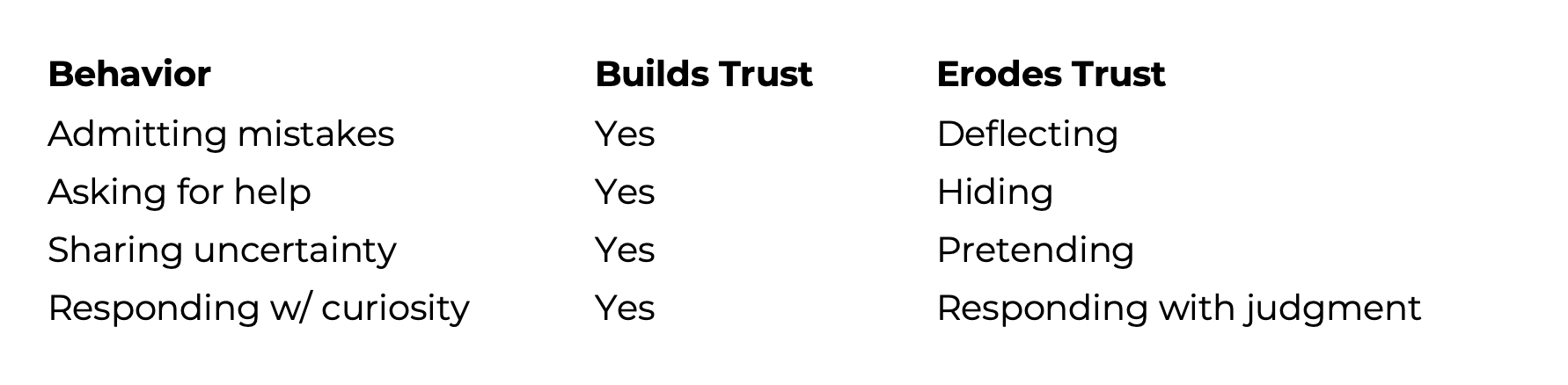
Here is a 4-question trust diagnostic:
Can I admit I made a mistake on this team?
Can I ask for help without looking incompetent?
Can I say I’m overwhelmed or unsure?
When others do those things, how do I respond?
Then map behaviors:
A Spiritual Tie-In
A beautiful alignment is Ether 12:27:
“I give unto men weakness that they may be humble…”
In other words:
God designed weakness as the pathway to connection, growth, and grace.
Lencioni says trust is built on vulnerability.
The gospel says vulnerability (weakness) is the mechanism God uses to refine us and bind us together.
They are describing the same human truth using secular and spiritual learning.
In other words:
Lencioni’s vulnerability-based trust is simply the organizational version of the gospel principle that weakness, honestly offered and compassionately received, is the foundation of real connection and growth!
Keep searching for these examples of building trust, and working to incorporate them into your own life you that you are found with an Abscense of Trust!
And please feel free to connect with me on LinkedIn:
-Jim Anderson